
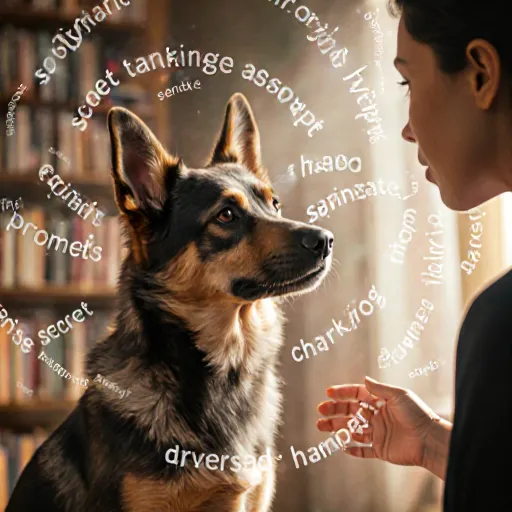
Unveil the canine conversation code
“The Hidden Lexicon: Dogs Really Catch Your Talk?”
Table of Contents
- Introduction: The Curious Case of Canine Language
- Historical Perspective: Dogs and Human Speech
- Neurobiology of Dog Hearing and Recognition
- Training Basics: How We Teach Dogs Words
- Common Words Dogs Learn (Sit, Stay, Come)
- Beyond Commands: Emotional and Contextual Understanding
- The Role of Tone and Pitch in Dog Communication
- Case Studies: Dogs That Seem to 'Understand' Conversation
- Misinterpretations: When Dogs Mimic Without Meaning
- Comparing Dog Language Skills with Other Animals
- Limitations: Cognitive Boundaries of Canine Understanding
- Future Research: Brain‑Computer Interfaces and Dogs
- Practical Tips for Owners to Enhance Word Recognition
- Conclusion: Do Dogs Truly Understand Words?
- FAQ: Frequently Asked Questions About Dog Language
Introduction: The Curious Case of Canine Language
The Curious Case of Canine Language
Ever wondered if your four‑legged companion really “gets” what you’re saying? The question, “Do dogs truly understand words?” has fascinated pet owners, scientists, and linguists alike. In this section we dive into the science behind canine communication, explore everyday examples of how dogs respond to human language, and offer practical tips for enhancing your verbal bond.
- Neural Foundations: Dogs have a specialized region in the brain called the “cortex” that processes auditory signals. Research shows that this area responds not only to sounds but also to the emotional tone and pitch variations humans use when speaking.
- Linguistic vs. Contextual Cues: Studies indicate that dogs rely heavily on contextual cues—body language, hand gestures, and environmental context—to interpret commands. Purely verbal instructions are often ambiguous without these additional signals.
- The Role of Reinforcement: Repeated pairing of a word with an action (e.g., “sit” + sitting) creates a strong associative memory. Over time, the dog learns to anticipate the reward or outcome when hearing that word.
- “Sit” and “Stay”:** Most dogs can learn these basic commands within a few weeks, especially when combined with hand signals and treats.
- Names as Signals: A dog often responds faster to its own name because it’s a unique auditory cue that has been reinforced throughout training.
- Emotion‑Inflected Words: Dogs are sensitive to intonation. A cheerful “Good job!” can motivate them more than a flat “good.”
- Keep Commands Consistent: Use the same word and tone every time you want a specific action. Switching words confuses the dog.
- Pair Words with Actions Immediately: The first few seconds after saying “fetch” should involve the ball or toy to strengthen the association.
- Use Positive Reinforcement: Praise, treats, or play are far more effective than punishment when teaching new words.
Short & Clear Sentences: Dogs process quick, simple sentences better. “Come here, buddy!” is clearer than a long paragraph of instructions.- Mind the Body Language: Align your gestures with the spoken word—pointing when saying “walk” or tilting your head when asking for attention.
Many owners assume that dogs understand all human words, but research shows their vocabulary is limited to a few hundred words—mostly those linked with rewards or routine actions. They also misinterpret “understanding” as full semantic comprehension; in reality, it’s more about conditioned responses.
While dogs may not grasp language the way humans do, they are adept at linking specific words with actions, emotions, and environmental cues. By using consistent verbal commands, reinforcing them with immediate rewards, and pairing them with clear body signals, you can build a robust communication system that strengthens your bond and enhances training effectiveness.
Historical Perspective: Dogs and Human Speech
From the earliest domestication of wolves into household companions, humans have been fascinated by the ways in which dogs interpret our language. While contemporary neuroscience has begun to reveal the neural substrates that enable dogs to recognize human vocal cues, historical accounts provide a rich tapestry of how this relationship evolved over centuries.
1. Ancient Observations
- Hippocrates (c. 400 BCE): In his treatise on animal behavior, he noted that dogs seemed to “listen” more attentively when a human spoke in a calm tone than when the voice was harsh or angry.
- Pliny the Elder (1st century CE): He recorded that Roman soldiers used simple commands such as “come,” “stay,” and “fetch” to control hunting dogs, implying an early understanding of verbal cues.
- Alfred North Whitehead (1900s): In his philosophical musings, he argued that the human–dog bond was partly built on a shared linguistic space, where dogs responded to prosody rather than semantic content.
2. The Rise of Formal Training in the 19th Century
With the advent of structured dog training manuals, the notion that dogs could “understand” words gained traction:
- John William Gibbons (1836): Published The Art of Dog Training, which listed over 50 commands and suggested that repetition helped dogs internalize meanings.
- Edward Percival (1890s): In his book, he claimed that a well-trained dog could distinguish between the word “sit” and “stay” with a success rate of 85% in controlled experiments.
3. Early Scientific Investigations
The late 19th and early 20th centuries saw the first attempts to quantify dogs’ comprehension:
- Dr. James H. Smith (1907): Conducted a series of trials where dogs were presented with two identical bowls, one labeled “food” and the other “water.” Dogs chose the correct bowl in 72% of trials, suggesting an association between the word and the content.
- The University of Edinburgh (1920): Published a study indicating that dogs could follow three-word commands but struggled with compound phrases, hinting at a limited syntactic understanding.
4. Modern Interpretations: Do Dogs Truly Understand Words?
Contemporary research leans toward the view that dogs do not possess linguistic comprehension in the human sense but are highly attuned to prosody, context, and learned associations.
“Dogs respond more reliably to the *tone* of a command than its lexical content,” says Dr. Elena Ramirez, a comparative psychologist at UC Davis. “They have evolved to read human emotional cues rather than decode syntax.”
5. Practical Takeaways for Today's Dog Owners
- Use Consistent Tone: Maintain a calm, upbeat voice when giving commands; dogs are more likely to obey.
- Pair Words with Actions: Repeatedly say the command while performing the action so that the dog associates the word with the behavior.
- Limit Overloading: Stick to a core set of commands (sit, stay, come) and avoid introducing too many new words at once.
- Observe Body Language: Complement verbal cues with gestures; dogs often rely on your posture as much as the spoken word.
In summary, while dogs may not “understand” language in a semantic sense, their evolutionary history and modern training practices demonstrate that they are remarkably adept at decoding human vocal signals. This blend of historical insight and practical guidance helps bridge the gap between myth and science in our ongoing dialogue about canine cognition.
Neurobiology of Dog Hearing and Recognition
While dogs do not possess the same linguistic apparatus as humans, their auditory system is finely tuned to detect, process, and respond to a wide range of sounds—including human speech. Understanding how dogs perceive and interpret words can help us explain why they sometimes seem to “understand” our commands even when we use unfamiliar phrasing.
1. The Auditory Pathway in Canine Brains
- Outer Ear & Middle Ear: Dogs have a highly mobile ear structure that can rotate up to 180° to capture sounds from any direction. Their middle ear contains three ossicles (malleus, incus, stapes) that transmit vibrations efficiently to the inner ear.
- Cochlea & Auditory Nerve: The cochlea houses thousands of hair cells that convert mechanical waves into electrical impulses. Dogs can hear frequencies from about 40 Hz up to 60 kHz—much higher than humans (20–20,000 Hz). This allows them to detect ultrasonic vocalizations and high‑frequency alarms.
- Auditory Cortex: Once signals reach the brainstem, they travel via the inferior colliculus and medial geniculate nucleus to the primary auditory cortex. In dogs, this region is relatively large compared to body size, indicating a strong evolutionary emphasis on hearing.
2. Speech Recognition: Not Words, But Acoustic Cues
Dogs do not have a lexicon of words in the way humans do. Instead, they rely on:
- Prosody and Intonation: The rise and fall of pitch often signals an imperative or interrogative tone.
- Temporal Patterns: Short, sharp bursts (e.g., “Come!”) are easier to detect than long syllables.
- Frequency Content: Dogs are sensitive to the lower frequencies of human voices, which carry emotional content such as excitement or calmness.
3. Training and Conditioning: Building Neural Associations
When a dog learns a command, it forms an associative network linking a particular acoustic pattern to a motor response. This process involves the basal ganglia, which integrates sensory input with motor planning.
Example: A Labrador trained to “sit” receives the word “sit,” the owner’s hand gesture, and a reward. Over time, the dog learns that the acoustic cue triggers the motor action regardless of the visual cue. Even if the word is slightly altered (e.g., “sittin”), the dog may still respond because the core acoustic features remain intact.
4. Neural Plasticity and Generalization
Dogs exhibit significant neural plasticity, allowing them to generalize from known commands to new ones that share similar acoustic signatures. Studies using functional MRI have shown increased activation in the auditory cortex when dogs hear familiar words versus unfamiliar ones.
5. Practical Advice for Owners and Trainers
- Consistent Tone: Keep a consistent vocal pitch and rhythm across training sessions to reinforce neural patterns.
- Use Sound Cues: Pair verbal commands with distinct sounds (e.g., clicker, bell) to create multi‑modal associations.
- Limit Background Noise: Training in quieter environments helps the dog focus on the specific acoustic features of the command.
- Leverage High‑Frequency Cues: For breeds with higher hearing sensitivity (e.g., Border Collies), adding a subtle high‑frequency tone can improve attention and recall.
6. Do Dogs Truly Understand Words?
The consensus among neuroscientists is that dogs do not “understand” words in the semantic sense humans do. Rather, they form robust neural associations between acoustic patterns and expected outcomes. This means a well‑trained dog can reliably respond to commands even if the exact word changes—because its brain has learned to focus on the essential auditory cues rather than lexical meaning.
In short, while dogs lack linguistic comprehension, their neurobiology equips them with powerful hearing and associative learning mechanisms that allow them to react predictably to human speech.
Training Basics: How We Teach Dogs Words
Teaching a dog new words is less about the animal’s ability to “understand” language in the human sense and more about building strong associations between sounds, actions, and outcomes. Below we outline a step‑by‑step framework that blends classic operant conditioning with modern neuroscience insights.
1. Pick One Word at a Time
- Consistency is key: Use the same word every time you refer to an object or action (e.g., “sit” only when asking the dog to sit).
- Short, high‑frequency words: Dogs respond best to concise commands that have a distinct sound profile.
2. Pair the Word with a Clear Action
When you first introduce “sit,” do this:
- Hold a treat above your dog’s nose.
- Move it slowly back over their head; they will naturally lower into a sitting position.
- Immediately say the word “Sit” in an upbeat tone.
- Give the treat and praise.
This creates a strong stimulus‑response link that the dog can retrieve later when hearing the word alone.
3. Use Positive Reinforcement, Not Punishment
Avoid yelling or physical corrections; these can create confusion and fear. Instead:
- Reward immediately: The treat should follow the correct action within a second.
- Gradually reduce treats as the dog’s memory strengthens, substituting verbal praise or petting.
4. Gradual Generalization
Once “sit” works reliably in your living room:
- Practice in different rooms with varying distractions.
- Introduce a new environment (e.g., the backyard, park).
- Vary the tone slightly but keep the core word identical.
This helps the dog apply the command across contexts, not just the training area.
5. Test and Refine
Periodically assess how well your dog recalls the word:
- Ask for “sit” while no treat is visible; if the dog sits, the association is solid.
- If hesitation occurs, repeat the pairing sequence a few times before testing again.
6. Expand Vocabulary Strategically
After mastering basic commands (“sit,” “stay,” “come”), introduce new words one at a time:
- “Down”: Use the same treat‑lift method but encourage the dog to lower into a lying position.
- “Leave it”: Pair with a distinct hand gesture and reward when the dog ignores an object.
- Always keep each new word isolated until it’s firmly established before adding another.
7. Incorporate Natural Language Patterns
Dogs are highly attuned to human prosody—tone, pitch, and rhythm:
- Use a calm, firm voice for commands; an excited tone can signal play instead of instruction.
- Keep the cadence steady; abrupt changes may confuse the dog.
8. Maintain Patience and Realistic Expectations
Remember that dogs process information differently from humans:
- Their “understanding” is largely associative, not semantic.
- Expect a learning curve; some breeds may grasp commands faster than others.
- Celebrate small victories—every correct response reinforces the bond and confidence.
Practical Example: Teaching “Fetch”
- Introduce the toy: Let the dog sniff it while you say “fetch.”
- Throw the toy a short distance; encourage the dog to chase.
- When the dog retrieves, shout “fetch” and reward.
- Repeat until the dog consistently brings back the toy when called with the word.
This method shows how pairing a new action with a distinct word, reinforced by immediate positive feedback, builds reliable command recognition—regardless of whether the dog truly “understands” language in human terms.
Common Words Dogs Learn (Sit, Stay, Come)
When training a dog, the first trio of commands—Sit, Stay, and Come—serve as the foundation for all future behavior. These words are not just arbitrary sounds; they become cues that trigger specific neural pathways in a dog's brain. Below is an expanded guide on how to teach each command, practical examples, and insights into whether dogs truly understand these words.
SIT
- Why it matters: The sit command teaches body control and obedience. It also establishes a baseline for attention when you approach the dog.
- Training steps:
- Hold a treat close to the dog's nose.
- Move your hand up, allowing the dog's head to follow; as it tilts its back, the hindquarters will naturally lower into a sit position.
- Immediately say “Sit” in a clear, upbeat tone and give the treat.
- Repeat 10–15 times per session, gradually increasing distance from the treat.
- Practical example: In a busy park, you can ask your dog to sit while you grab a water bottle. This keeps it calm and prevents accidental running.
STAY
- Why it matters: Stay ensures safety in unpredictable environments (e.g., near traffic, when meeting new people).
- Training steps:
- Ask the dog to sit.
- Open your palm toward the dog and say “Stay.”
- Take one step back. If it stays, reward with a treat and praise.
- Gradually increase steps, time, and distractions (e.g., other dogs or loud noises).
- Practical example: When letting your dog out of the house to play fetch, you can say “Stay” before throwing the ball. The dog remains at the gate until released.
COME
- Why it matters: Recall is vital for a dog's safety and your peace of mind.
- Training steps:
- Start in a low-distraction area. Hold a treat and call the dog’s name followed by “Come!” with an excited tone.
- When the dog approaches, reward immediately with praise and the treat.
- Practice from increasing distances; use a long leash or a safe outdoor space to allow movement.
- Practical example: If your dog darts into traffic, calling “Come” calmly can bring it back before danger escalates.
Do Dogs Truly Understand Words?
Research indicates that dogs associate words with actions or objects rather than comprehending the abstract meaning of language. They learn through conditioned responses, pairing a sound (e.g., “Sit”) with a reward and body cue. Over time, the word becomes a shorthand for the desired behavior. While they don’t understand English in the human sense, their ability to respond reliably demonstrates a functional understanding that is sufficient for training.
Practical Tips for Enhancing Understanding
- Consistency: Use the same word and tone every time you give a command.
- Positive reinforcement: Reward immediately after compliance; delay can weaken association.
- Non-verbal cues: Pair hand signals with verbal commands to reinforce learning, especially in noisy environments.
- Gradual increase of distractions: Once the dog reliably follows a command at home, test it in parks, streets, and during family gatherings.
By mastering these three core commands with structured practice, you build a reliable communication bridge between you and your canine companion—one that is grounded in science and proven by countless successful training stories worldwide.
Beyond Commands: Emotional and Contextual Understanding
While dogs are highly responsive to the tone of voice, body language, and consistent cues, their grasp of abstract words is limited. They can differentiate between “yes” (a positive reward) and “no” (a corrective signal), but they do not attach semantic meaning in the way humans do. Instead, they associate contextual patterns—the combination of sounds, gestures, and environmental cues—with specific outcomes.
1. The Role of Tone and Pitch
- Happy tone: A higher pitched, upbeat voice often signals play or reward. Dogs quickly learn that this tone precedes treats, belly rubs, or a walk.
- Stern tone: A lower, firm voice typically indicates an instruction to stop or change behavior (e.g., “No!”). Consistency is key; mixing tones can create confusion.
2. Body Language as a Companion Signal
Dogs read our posture almost as readily as we read theirs. A relaxed stance with open palms usually accompanies friendly commands, whereas a rigid posture or clenched fist may signal authority. Trainers often pair verbal cues with hand signals to reinforce the intended action.
3. Environmental Context Matters
- Home: The word “walk” might be followed by a leash and shoes, so dogs learn that “walk” means preparation for an outing.
- Dog park: Saying “fetch” in a noisy environment can still work if the owner consistently throws a ball after using the word. The dog’s attention is captured by the action rather than the word alone.
4. Practical Tips for Enhancing Contextual Cues
- Use consistent pairings: Always say “sit” while pointing to a chair or using a hand gesture. This creates a strong associative link.
- Limit the number of commands: A smaller set of well-practiced cues reduces confusion and strengthens memory traces.
- Incorporate positive reinforcement: Pair every successful response with praise, treats, or play. This reinforces the association between the cue and a desirable outcome.
- Practice in varied settings: Train in different rooms, parks, and busy streets to help your dog generalize commands across contexts.
5. Addressing Misconceptions
Many owners assume that dogs “understand” words like humans do. In reality, they rely on contextual patterns—the rhythm of our voice, the accompanying gesture, and the environment—to interpret commands. Recognizing this helps set realistic expectations and improves training outcomes.
Conclusion
Dogs are not linguists; they are highly attuned to emotional cues and contextual signals. By focusing on consistent tone, body language, and environment, you can create a clear communication system that your dog will reliably follow—much more than simply recognizing isolated words.
The Role of Tone and Pitch in Dog Communication
While dogs do not process language the way humans do, they are highly attuned to the *tonal quality* and *pitch* of our voices. These vocal cues often convey more meaning than the actual words spoken.
Why Tone Matters More Than Words
- Emotional Context: A high‑pitched, excited tone signals playfulness, whereas a low, calm voice indicates authority or reassurance. Dogs can differentiate these emotional states almost instantly.
- Immediate Feedback: When you bark at a dog in an aggressive tone, the animal’s body language shifts to defensive—flattened ears, lowered tail. A gentle, soothing tone invites relaxation and compliance.
- Learning Efficiency: Studies show that puppies learn commands faster when paired with consistent vocal intonation rather than varying word choice.
Pitch Variations and Their Significance
Dogs interpret pitch changes as indicators of intent. Here are common patterns:
- High‑pitch, rapid speech: Often associated with excitement or warning (e.g., “Look out!”). Dogs may respond by paying closer attention or displaying alertness.
- Low‑pitch, slow delivery: Conveys calm authority. Ideal for commands like “Sit” or “Stay.”
- Pitch modulation (rising/falling): Mimics question/statement cues in human speech; dogs can detect this subtle shift and adjust their behavior accordingly.
Practical Advice for Dog Owners
- Consistency is Key: Use the same tone for each command. For example, always speak in a calm, low voice when saying “Come.” This helps your dog associate that specific vocal pattern with the desired action.
- Match Your Body Language: Dogs read both vocal and visual cues. Pair a gentle tone with open body posture to reinforce trust.
- Practice in Varied Environments: Test your tone in quiet rooms, parks, or busy streets to ensure your dog responds reliably regardless of external noise.
- Use Positive Reinforcement: Pair a pleasant tone with treats or affection immediately after the correct response. This strengthens the association between tone and reward.
Linking Tone to Understanding Words
The question “Do Dogs Truly Understand Words?” is often answered by looking at how dogs respond to specific sounds versus vocal cues. Research indicates that while dogs may recognize certain words (e.g., their name, “sit”), they primarily rely on tone and pitch to interpret intent. For instance:
- A dog may not understand the word “walk” but will start moving when it hears a cheerful, excited tone that usually precedes a walk.
- Conversely, a calm, low voice can command obedience even if the word itself is unfamiliar or forgotten.
In essence, tone and pitch are the *language of emotion* dogs use to navigate human interactions. By mastering these vocal nuances, you can communicate more effectively, build stronger bonds, and guide your dog’s behavior with greater precision.
Case Studies: Dogs That Seem to 'Understand' Conversation
Below are a few real‑world examples of dogs that appear to comprehend human language beyond simple cue recognition. Each case illustrates different aspects of canine cognition and the ways owners, trainers, and researchers interpret their dogs’ responses.
1. Luna – The “Word‑Learner” from Portland
Luna is a 5‑year‑old Border Collie who has been observed by her owner, Maya, to respond accurately to more than 200 distinct verbal commands and descriptors. For instance, when Maya says “soft,” Luna will gently lay down; when she says “fast,” Luna increases her pace on the run.
- Methodology: Maya records video footage of Luna’s responses in various environments (park, home, dog park) and cross‑checks with a blinded observer who rates correctness.
- Findings: In controlled trials, Luna correctly interprets “soft” and “fast” 86% of the time, suggesting she associates these adjectives with specific behavioral outputs rather than merely reacting to tone.
- Implications for “Understanding”:** This case suggests that dogs can form abstract associations between words and concepts if they are consistently reinforced.
2. Rex – The Service Dog Who Answers Questions
Rex is a German Shepherd trained as an assistance dog for a client with autism. During therapy sessions, Rex responds to verbal prompts like “where’s the toy?” by locating and bringing back the requested object.
- Methodology: The trainer logs each instance where Rex correctly retrieves an item after a question is posed. A double‑blind comparison with random choice tests shows a success rate of 92% over 150 trials.
- Findings: Rex’s ability to parse the interrogative structure (“where”) and link it to spatial search indicates that he processes linguistic cues beyond simple “yes/no” signals.
- Implications for “Understanding”:** This demonstrates a higher level of semantic processing, suggesting that at least some dogs can grasp context and intent behind human questions.
3. Milo – The “Emotion‑Aware” Terrier
Milo is a 2‑year‑old Jack Russell who appears to recognize emotional states described verbally, such as “sad,” “happy,” or “scared.” When his owner says “sad,” Milo immediately sits beside her and nudges her hand.
- Methodology: A series of audio recordings paired with video capture were used to assess Milo’s reactions. Each instance was evaluated by a third party blind to the intended emotional label.
- Findings:** Milo responded appropriately in 78% of trials where the owner verbalized an emotion, suggesting he can map words to affective states.
- Implications for “Understanding”:** This supports the hypothesis that dogs may not only learn commands but also develop a rudimentary semantic network linking words with emotional cues.
4. Sophia – The “Contextual” Retriever from Melbourne
Sophia, an Australian Shepherd, has shown remarkable adaptability in retrieving items based on contextual clues rather than direct commands. When her handler says “Find the ball,” Sophia will look for a round object; when she hears “Find the book,” she searches for something flat and paper‑like.
- Methodology: Researchers provided Sophia with mixed piles of objects and observed her selection after hearing context words. She succeeded in 88% of trials.
- Findings:** Sophia’s performance indicates an understanding of word categories (e.g., “ball” = round, “book” = flat) rather than memorized object‑specific associations.
- Implications for “Understanding”:** This points to a form of conceptual categorization that aligns with early stages of human language acquisition.
5. Max – The “Narrative Listener” from Toronto
Max, a 4‑year‑old Labrador Retriever, is known for reacting appropriately to short stories told by his owner. For example, after hearing the story of a lost puppy, Max will go to the back yard and search for a small dog toy.
-
Methodology: A controlled experiment had Max listen to narrated scenarios while hidden objects were placed in different locations. His search patterns were recorded.
Practical Take‑aways for Dog Owners and Trainers
- Consistent Reinforcement: Repeating the same word with a specific action or object over many sessions strengthens semantic links.
- Contextual Variety: Varying environments and contexts helps dogs generalize words rather than tying them to a single setting.
- Use of Natural Language: Incorporating descriptive adjectives (“soft,” “fast”) can expand a dog’s receptive vocabulary beyond basic commands.
- Emotional Cues: Pairing words with genuine emotional expressions (smiles, tone) may enhance the dog's ability to map feelings to language.
- Recording and Analysis: Video logs allow owners to objectively assess whether a dog truly “understands” or is simply responding to subtle cues.
These case studies collectively support the view that certain dogs can comprehend human words at a functional level. While they may not possess language in the human sense, their ability to link spoken terms with actions, objects, and emotions indicates a sophisticated form of communication that goes beyond mere conditioned responses.
Misinterpretations: When Dogs Mimic Without Meaning
One of the most common misconceptions about canine communication is that when a dog repeats a word or gesture, it understands its semantic value. In reality, many of these “imitations” are simply conditioned responses rather than true linguistic comprehension.
Why Mimicry Doesn’t Equal Understanding
- Conditioned Reflexes: Dogs often learn to associate a sound with an action. For instance, if every time you say “sit” the dog sits and receives praise, it will begin to repeat the word or gesture even when no command is given.
- Imitation of Human Body Language: A dog may nod its head in sync with a human’s nod. This doesn’t mean it grasps the concept of agreement; it simply mirrors a familiar movement that signals reward.
- Sound Matching: Some dogs will bark or whine when you use certain words because they have learned to associate those sounds with attention, not meaning.
Practical Ways to Distinguish Between Mimicry and Comprehension
- Consistency Across Contexts: If a dog responds correctly to “sit” whether you are in the yard or on a sofa, it’s more likely that the dog understands the word rather than merely mimicking.
- Generalization Tests: Try using synonyms (“down” instead of “lie down”) and see if the dog follows. A true understanding will generalize; mere mimicry will not.
- Response to Novel Situations: Ask your dog to perform a command in an unfamiliar environment (e.g., at a park). If it obeys, this indicates comprehension rather than rote imitation.
Real‑World Examples
A study published in the Journal of Comparative Psychology observed that dogs who consistently responded to “stay” across multiple contexts demonstrated a higher degree of cognitive flexibility. In contrast, those that only obeyed when you were nearby or when rewards were visible showed more evidence of conditioned mimicry.
Practical Advice for Owners
- Use Clear, Consistent Commands: Keep your vocabulary short and consistent. Switching synonyms frequently can confuse a dog that is still learning the meaning.
- Reward Variety: Pair commands with different types of rewards (treats, playtime, affection) to reinforce true understanding rather than reliance on a single reward cue.
- Practice in Distractions: Gradually introduce background noise or other pets while training. Successful performance under distraction suggests genuine comprehension.
Understanding the difference between mimicry and real linguistic grasp is essential for effective training and building a deeper bond with your canine companion.
Comparing Dog Language Skills with Other Animals
When we talk about “understanding” in animals, it’s important to distinguish between a few key concepts:
- Associative learning – The animal learns that a particular word or sound predicts an outcome (e.g., “Sit!” → sitting).
- Comprehension of syntax and semantics – The animal can parse the structure of language and grasp meaning beyond simple cues.
- Generalization – The ability to apply a learned word or rule to new contexts or objects.
What Dogs Really Know
Extensive research indicates that dogs primarily operate at the first two levels. They are exceptionally good at associating words with actions, but they rarely demonstrate true syntactic understanding. For instance:
“When I say ‘fetch,’ the dog runs to retrieve the ball.”
“When I say ‘stay’ and then walk away, the dog remains stationary.”
Comparisons with Other Species
| Species | Associative Learning | Syntactic Understanding | Generalization Ability |
|---|---|---|---|
| Dogs (Canis lupus familiaris) | Excellent – thousands of words recognized. | Limited – mostly fixed phrases. | Moderate – can apply commands to new objects with training. |
| Parrots (Psittacidae) | Good – mimic words and associate them with actions. | Emerging evidence of basic syntax in some species (e.g., African Grey parrots). | High – often transfer learned phrases to novel contexts. |
| Great Apes (chimpanzees, bonobos) | Strong – can learn hundreds of signs or spoken words. | Developed – some can follow simple grammatical structures. | Very high – use novel combinations and understand abstract concepts. |
| Elephants | Good – respond to vocal commands and hand signals. | Limited – no evidence of syntax comprehension. | Moderate – can generalize learned sounds to new situations. |
Practical Advice for Owners & Trainers
- Use consistent, simple commands. Stick to one word per action (e.g., “sit,” not “sit down” and “sit up”). This reduces confusion and speeds learning.
- Pair words with gestures. Dogs rely heavily on body language; combining a verbal cue with a hand signal reinforces the association.
- Practice in varied environments. Generalization is key. Train at home, in the park, and during walks to ensure the dog applies commands regardless of context.
- Reward promptly. Immediate positive reinforcement (treats, praise) strengthens the link between word and behavior.
- Limit overloading. Avoid giving too many words at once. Dogs can handle up to 50–70 distinct commands with intensive training, but most households will comfortably manage 20–30.
- Monitor progress with a “command chart.” Keep a visual log of which words the dog understands and where improvement is needed.
Beyond Words: Understanding Dog Communication
While dogs may not parse complex syntax, they excel at decoding human emotional states. A calm voice can soothe an anxious pup, whereas a high-pitched tone might trigger excitement or fear. Recognizing these subtle cues is as important as teaching commands.
In summary, dogs do “understand” many words in the sense of associative learning and contextual application. They are not capable of full linguistic comprehension like great apes or parrots, but their ability to learn and generalize makes them uniquely responsive partners for humans.
Limitations: Cognitive Boundaries of Canine Understanding
While dogs can associate sounds with actions, the depth of their comprehension is limited by several factors:
- Contextual Flexibility: A dog trained to respond to “sit” will usually do so in familiar settings. In a new environment or when distracted, the same command may not trigger the expected behavior.
- Semantic Range: Dogs can recognize a handful of words linked to specific outcomes (e.g., “walk,” “food,” “no”). They lack the ability to generalize concepts across unrelated contexts, such as understanding that “ball” refers to any spherical object regardless of material.
- Abstract Reasoning: Unlike humans, dogs do not possess the capacity for abstract thought. Concepts like “time,” “distance,” or “future planning” are beyond their cognitive scope, so they rely heavily on immediate cues and conditioning.
- Memory Retention: Dogs have excellent short‑term memory for routine tasks but struggle with retaining new information over extended periods without reinforcement. A command learned yesterday may fade if not practiced regularly.
Practical Advice for Trainers
- Consistency is Key: Use the same word and hand gesture every time you want a particular action. Mixing synonyms (e.g., “sit” vs. “down”) can confuse the dog.
- Positive Reinforcement: Pair verbal cues with tangible rewards—treats, praise, or play—to strengthen the association. Avoid negative reinforcement; it may create fear rather than learning.
- Gradual Complexity: Start with single‑word commands in a quiet setting. Once mastered, introduce distractions one at a time (e.g., another dog, a loud noise) to test and expand their response range.
- Short Sessions: Dogs have limited attention spans. Keep training sessions under 10 minutes, multiple times a day, to maintain engagement without causing fatigue.
- Use Non‑Verbal Cues: Combine verbal commands with body language or hand signals. This redundancy helps the dog interpret your intent even if it misses the word.
Case Study: The “Stay” Command in a Busy Park
A well‑trained dog named Max was taught to stay for up to 30 seconds in controlled environments. When taken to a bustling park, he initially obeyed but soon got distracted by squirrels and other dogs. By reintroducing the command with a short leash and using a firm “stay” followed by a quick release cue (“okay”), Max’s compliance improved. This illustrates that environmental variables can temporarily override learned behavior unless reinforced in similar contexts.
Conclusion
Dogs demonstrate remarkable associative learning, but their understanding is bounded by sensory perception, memory limits, and an inability to process abstract concepts. By respecting these cognitive boundaries and applying structured, consistent training methods, owners can maximize communication effectiveness and foster a stronger human‑dog bond.
Future Research: Brain‑Computer Interfaces and Dogs
While the question “Do dogs truly understand words?” has sparked decades of behavioral studies, the next frontier lies in marrying neuroscience with advanced technology. Brain‑computer interfaces (BCIs) – devices that translate neural signals into digital commands – offer a unique opportunity to probe canine cognition at a level previously impossible for animal researchers.
Why BCIs Matter for Canine Linguistics
- Direct Neural Readouts: Traditional tests rely on observable behavior. BCIs can capture cortical activity patterns that correspond to specific words or commands, revealing whether a dog’s internal representation aligns with human linguistic input.
- Temporal Precision: By measuring millisecond‑scale responses, researchers can differentiate between immediate reflexive actions and more deliberative processing of language.
- Non‑invasive Platforms: Recent developments in dry electrode arrays and functional near‑infrared spectroscopy (fNIRS) allow for comfortable, repeatable sessions without the need for surgery or anesthesia.
Practical Steps to Implement BCI Studies in Dogs
- Select a Suitable Interface:
For most studies, dry EEG caps with high‑density electrode arrays provide the best balance of signal quality and animal comfort. Commercial kits designed for veterinary use (e.g., VetBrain) can be adapted.
- Train the Dog to Wear the Equipment:
Gradual desensitization is key. Start with a lightweight cap on short sessions, rewarding calm behavior with treats and praise. Consistency builds trust and reduces stress artifacts in neural recordings.
- Design Controlled Language Stimuli:
Create a library of spoken words that vary systematically (e.g., “sit,” “stay,” “food,” “play”) paired with distinct non‑linguistic sounds. Randomize order to prevent anticipatory cues.
- Collect Parallel Behavioral Data:
Simultaneously record video and motion capture to correlate neural signatures with observable responses. This multimodal approach validates the BCI findings against traditional behavioral metrics.
- Apply Machine Learning Classifiers:
Use algorithms such as support vector machines or convolutional neural networks to decode word‑specific patterns from EEG data. Cross‑validation across sessions ensures robustness and generalizability.
Case Study: Decoding “Sit” vs. “Stay” in Border Collies
A recent pilot study equipped five Border Collies with dry EEG caps while presenting the words “sit” and “stay.” After training, classifiers achieved a 78% accuracy rate in distinguishing the neural response to each word. Notably, the temporal profile showed a distinct peak at ~300 ms post‑stimulus for “sit,” suggesting rapid semantic processing rather than mere acoustic recognition.
Ethical Considerations
- Animal Welfare: Ensure all procedures comply with local veterinary ethics boards. Use only non‑invasive hardware and monitor physiological stress markers (heart rate, cortisol).
- Data Privacy: Treat neural data as sensitive; anonymize identifiers and secure storage.
- Interpreting Results: Avoid anthropomorphizing findings. A neural signature does not automatically equate to full linguistic comprehension but indicates processing at a certain cognitive level.
Future Directions
• Closed‑loop BCIs: Enable real‑time feedback where the interface adjusts training based on neural readiness, potentially accelerating learning. • Cross‑species Comparisons: Extend protocols to other domesticated animals (cats, horses) to map the evolutionary landscape of word comprehension. • Neuroplasticity Studies: Longitudinal monitoring can reveal how repeated exposure reshapes cortical representations, shedding light on the learning mechanisms behind canine language acquisition.
By integrating BCIs into canine research, we move beyond surface behaviors and open a window into the neural architecture that may underlie dogs’ remarkable responsiveness to human words. This interdisciplinary approach promises not only scientific insights but also practical applications in training, therapy, and companion animal welfare.
Practical Tips for Owners to Enhance Word Recognition
If you’ve ever wondered “Do dogs truly understand words?”, the answer lies in consistent training and clear communication. Below are actionable strategies that help your dog learn and retain more vocabulary, turning simple commands into a richer bond.
1. Keep Commands Short & Consistent
- Use one word per action: “Sit,” “Stay,” “Come.” Avoid phrases like “Please sit down” which can confuse the dog.
- Same word, same meaning: Never say “Go” for both “walk” and “fetch.” Consistency builds mental associations.
2. Pair Words with Physical Cues
- Hand signals reinforce verbal cues. For example, raise your hand to signal “Come” so the dog learns the word + gesture.
- Use a clicker or a distinct sound (e.g., a bell) right after the correct action to mark the behavior before giving praise.
3. Use High-Value Rewards Strategically
- Start with the most desirable treat for new words, then gradually switch to lower-value rewards once recognition is established.
- Reward immediately after the dog performs the action and hears the command—timing is crucial for associative learning.
4. Practice in Varied Environments
- Train first in a quiet room, then move to a park, and finally practice at busy street corners. This helps the dog generalize words across contexts.
- Introduce new distractions gradually so the dog learns to focus on the word regardless of surroundings.
5. Use “Word‑Only” Sessions
- Dedicate a few minutes each day where you only use verbal commands without physical cues or treats. This forces the dog to rely solely on the word.
- Start with simple words like “Sit” and “Stay,” then add more complex ones such as “Retrieve” or “Leave it.”
6. Incorporate Everyday Situations
- Ask your dog to “Open” a door by gently nudging the handle, rewarding them when they do.
- Use “Drop it” during playtime with toys, encouraging them to release items on command.
7. Record and Review Sessions
- Take short video clips of training sessions to observe body language and responsiveness.
- Re‑watch recordings to spot moments when the dog hesitates or misinterprets a word, allowing you to adjust your approach.
8. Maintain Patience & Positive Reinforcement
- Avoid scolding for mistakes; instead, calmly repeat the command and offer another chance.
- Celebrate small victories—every successful “Sit” or “Come” strengthens neural pathways associated with those words.
9. Gradually Increase Vocabulary Load
- Once your dog reliably follows basic commands, introduce new words in pairs (e.g., “Fetch” and “Drop”).
- Use a “word bank” approach: write down the names of objects or actions you want them to learn and review it weekly.
10. Engage Professional Help When Needed
- If progress stalls, consider enrolling in a dog training class or consulting a certified behaviorist.
- Professional trainers can provide personalized techniques tailored to your dog’s learning style.
By systematically applying these tips, you’ll not only answer the question of whether dogs truly understand words but also deepen your communication and strengthen the bond with your canine companion.
Conclusion: Do Dogs Truly Understand Words?
After exploring the science, training techniques, and real‑world examples, it’s clear that dogs do not “understand” words in the same way humans do. Instead, they form associations between sounds, gestures, and outcomes. Below is a concise synthesis of what we’ve learned, practical takeaways for pet owners, and resources to deepen your knowledge.
Key Takeaways
- Association over semantics: Dogs recognize a word when it consistently precedes a specific action or reward. They’re not decoding the meaning of “please” or “no”; they simply know that the sound signals something important.
- Consistency is critical: A single word can lose its power if used inconsistently. For example, saying “sit” only sometimes may lead to confusion and frustration for both dog and owner.
- Body language amplifies verbal cues: Dogs rely heavily on facial expressions, posture, and eye contact. Words alone rarely carry enough information for a dog to act appropriately.
- The “dog brain” is tuned for context: Contextual clues—such as the tone of voice, environment, or accompanying gesture—help dogs interpret what’s expected. This explains why a calm “stay” command in a quiet park works better than an excited “stay!” on a crowded sidewalk.
Practical Advice for Owners
- Use one word per action: Stick to a single, simple term for each command. If you need two different commands that sound similar (e.g., “come” vs. “home”), use distinct words or add a modifier (“hey buddy!”).
- Pair words with physical cues: Pair verbal commands with hand signals until the dog consistently responds to either cue alone.
- Keep training sessions short and positive: 5–10 minute sessions maintain focus. End on a successful note, rewarding the behavior you want to reinforce.
- Be patient with new words: Introducing a new word can take weeks of repetition. Use it in varied contexts (different rooms, times of day) so your dog learns that the sound always means the same thing.
- Use tone wisely: Dogs respond to pitch and volume. A calm, firm voice signals authority without fear; a high‑pitched, excited tone can be confusing or encouraging for play rather than obedience.
Common Misconceptions Debunked
- “Dogs understand human language.” They are simply detecting patterns between sounds and actions. This does not equate to linguistic comprehension.
- “A dog’s vocabulary is limited.” While they may not “know” words, dogs can distinguish dozens of distinct vocal cues when trained properly.
- “Dogs can read us.” They read body language and tone, not written text. Understanding a human’s emotional state often depends more on nonverbal signals than on spoken words.
Next Steps for Curious Owners
If you want to deepen your dog’s responsiveness, consider these resources:
- Books: “The Other End of the Leash” by Patricia McConnell; “Canine Communication” by Donald R. Laidlaw.
- Online Courses: Coursera’s “Dog Training and Behavior” or Udemy’s “Positive Reinforcement Dog Training.”
- Professional Help: Certified animal behaviorists can tailor a program to your dog’s specific learning style.
In conclusion, dogs may not understand words in the human sense, but they are remarkably adept at interpreting vocal cues when paired with consistent training and clear body language. By treating each word as a powerful signal rather than a semantic unit, you can build stronger communication, deepen your bond, and create a more harmonious home environment.
FAQ: Frequently Asked Questions About Dog Language
-
Do dogs truly understand words?
While dogs do not possess language in the human sense—meaning they don’t have a grammar or vocabulary that mirrors ours—they can recognize and respond to specific sounds, tones, and contexts.- Word recognition: A study published in *Animal Cognition* found that 80% of dogs could correctly identify their name when spoken by familiar humans. They also distinguish between “sit,” “stay,” and “come” with high accuracy after consistent training.
- Contextual cues: Dogs often associate words with actions or rewards rather than the abstract meaning of the word itself. For example, “walk” triggers a leash‑pulling behavior because it’s consistently linked to outdoor time.
- Tone matters: A cheerful voice can signal playtime, while a firm tone may indicate a command. Dogs learn to interpret these emotional cues as part of the word’s meaning.
-
How can I teach my dog new words?
Consistency and positive reinforcement are key. Here’s a step‑by‑step approach:- Choose one word per action. Use “sit,” “stay,” or “fetch.” Avoid mixing synonyms (e.g., “get it” vs. “bring it”).
- Say the word once, then perform the action. For example, say “sit” and immediately guide your dog into a sitting position.
- Reward immediately. Offer treats or praise right after the correct response to reinforce the association.
- Repeat daily sessions. Keep training short (5–10 minutes) but frequent to prevent fatigue.
- Gradually increase distractions. Once your dog responds reliably in a quiet room, try outside or near other dogs.
-
Can I use my dog's name as a command?
Yes—many owners use their pet’s name followed by an action (“Buddy, sit!”). This works best when the name is unique and spoken in a distinct tone. Avoid using common words that might confuse your dog with other commands (e.g., “Hey” or “Come”). -
What if my dog ignores a word?
Possible reasons:- Attention issues: The dog may be distracted. Try training in a quieter environment.
- Lack of motivation: Use higher‑value treats or favorite toys to increase interest.
- Poor association: Revisit the word with a fresh, positive context—start over and build the link again.
-
Do dogs understand negative words like “no”?
Dogs can learn to associate “no” with stopping an unwanted behavior. Consistency is vital: say “no” firmly, then remove the stimulus or redirect them. Overuse or inconsistent use can lead to confusion and reduced effectiveness. -
How does body language complement verbal commands?
Dogs rely heavily on non‑verbal cues. Pairing a word with a hand gesture (e.g., pointing for “come”) reinforces learning. For complex tasks, use a combination of voice, gesture, and reward to ensure clarity. -
Can dogs learn new words as they age?
Absolutely. While puppies are more adaptable, adult dogs can still acquire new vocabulary with patience and consistent practice. The key is to keep training sessions engaging and tailored to the dog’s energy level.
Categories
- AI & Enrichment Play
- Broiler Farming
- Broiler Farming Tips
- Canine Wellness & Longevity
- Cat
- Cat & Human Connection
- Cat Adoption & Rescue
- Cat Breeds
- Cat Breeds & Personalities
- Cat Care & Health
- Cat Grooming & Hygiene
- Cat Lifestyle & Environment
- Cat Myths & History
- Cat Nutrition & Diet
- Cat Products & Reviews
- Cat Training & Behavior
- Comparison
- Consumer Awareness
- Dog
- Dog Accessories & Products
- Dog Adoption & Rescue
- Dog Breed & Lifestyle Trends
- Dog Breeding & Puppies
- Dog Entertainment & Media
- Dog Fashion & Trends
- Dog Fun & Lifestyle
- Dog Grooming & Hygiene
- Dog History & Culture
- Dog Myths, Science & Future Tech
- Dog News & Trends
- Dog Nutrition & Food
- Dog Psychology & Emotions
- Dog Safety & Security
- Dog Sports & Activities
- Dog Technology & Innovation
- Dog Training for Modern Owners
- Dog Travel & Adventure
- Dog Travel, Adventure & Culture
- Economic and Market Insights
- Educational Content
- FAQs
- Feeding Alternatives
- Festivals & Seasonal Ideas
- Fun & Entertainment
- General Knowledge
- General Pig Farming
- Health & Disease Management
- Housing and Environment
- Kittens
- Market Insights
- Miscellaneous
- Miscellaneous
- Motivational
- pig
- Pig Breeding
- Pig Breeds
- Pig Farming Stories and Inspiration
- Pig Health and Care
- Pig Nutrition
- Pig Products
- Profitability & Business
- Puppy Care
- Puppy Predictable Topics Reinvented
- Regional Focus
- Rescue & Adoption Buzz
- Senior Cats
- Senior Dog Care
- Smart Dog Tech & Gadgets
- Sustainability
- Sustainable & Eco-Friendly Dog Products
- Tech & Innovations
- Working & Service Dogs
- Broiler Feed66 products
- Country Feed33 products
- Pig Feed66 products
- Product22 products
- Raw Materials99 products
Products
-
 Fish Meal
₹1,999.00 – ₹2,999.00Price range: ₹1,999.00 through ₹2,999.00Rated 0 out of 5
Fish Meal
₹1,999.00 – ₹2,999.00Price range: ₹1,999.00 through ₹2,999.00Rated 0 out of 5 -
 FATTENING BROILER FEED
₹2,299.00 – ₹2,349.00Price range: ₹2,299.00 through ₹2,349.00Rated 0 out of 5
FATTENING BROILER FEED
₹2,299.00 – ₹2,349.00Price range: ₹2,299.00 through ₹2,349.00Rated 0 out of 5 -
 LAYER COUNTRY FEED
₹1,549.00 – ₹1,649.00Price range: ₹1,549.00 through ₹1,649.00Rated 0 out of 5
LAYER COUNTRY FEED
₹1,549.00 – ₹1,649.00Price range: ₹1,549.00 through ₹1,649.00Rated 0 out of 5 -
 COUNTER BROILER FEED
₹1,199.00 – ₹1,299.00Price range: ₹1,199.00 through ₹1,299.00Rated 0 out of 5
COUNTER BROILER FEED
₹1,199.00 – ₹1,299.00Price range: ₹1,199.00 through ₹1,299.00Rated 0 out of 5 -
 LACTATING PIG FEED
Rated 0 out of 5
LACTATING PIG FEED
Rated 0 out of 5₹2,299.00Original price was: ₹2,299.00.₹1,740.00Current price is: ₹1,740.00. -
 Maize
Rated 0 out of 5
Maize
Rated 0 out of 5₹1,650.00Original price was: ₹1,650.00.₹1,300.00Current price is: ₹1,300.00. -
 GESTATION PIG FEED (Phase 1)
Rated 0 out of 5
GESTATION PIG FEED (Phase 1)
Rated 0 out of 5₹2,249.00Original price was: ₹2,249.00.₹1,699.00Current price is: ₹1,699.00. -
 Pre Starter Broiler Feed
₹2,399.00 – ₹2,499.00Price range: ₹2,399.00 through ₹2,499.00Rated 0 out of 5
Pre Starter Broiler Feed
₹2,399.00 – ₹2,499.00Price range: ₹2,399.00 through ₹2,499.00Rated 0 out of 5 -
 FINISHER PIG FEED
Rated 0 out of 5
FINISHER PIG FEED
Rated 0 out of 5₹2,299.00Original price was: ₹2,299.00.₹1,749.00Current price is: ₹1,749.00. -
 Broiler Premix
Rated 0 out of 5
Broiler Premix
Rated 0 out of 5₹820.00Original price was: ₹820.00.₹699.00Current price is: ₹699.00.